1. The HEP Is Already a Standard — RTM Should Be Too
As a musculoskeletal (MSK) clinician specifically, a physical therapist I'll say it plainly: Remote Therapeutic Monitoring (RTM) should be a standard of care. Bold take? Maybe. But hear me out. Every MSK patient who walks through a PT clinic's doors would benefit from, and should be receiving, a home exercise program (HEP). The evidence is abundant, overwhelming research supports daily movement, and even more shows that both aerobic and anaerobic exercise are essential for treating musculoskeletal and neurological conditions.
And yet, here's the reality:
- Patient adherence to HEPs remains one of the biggest pain points in MSK care.
- HEPs have evolved from generic, photocopied sheets to highly customized, digital programs tailored to each patient.
- PT itself has shifted away from passive, table-based treatments toward active care that gets patients moving, building function, and promoting independence.
2. You Can't Really Have RTM Without HEP
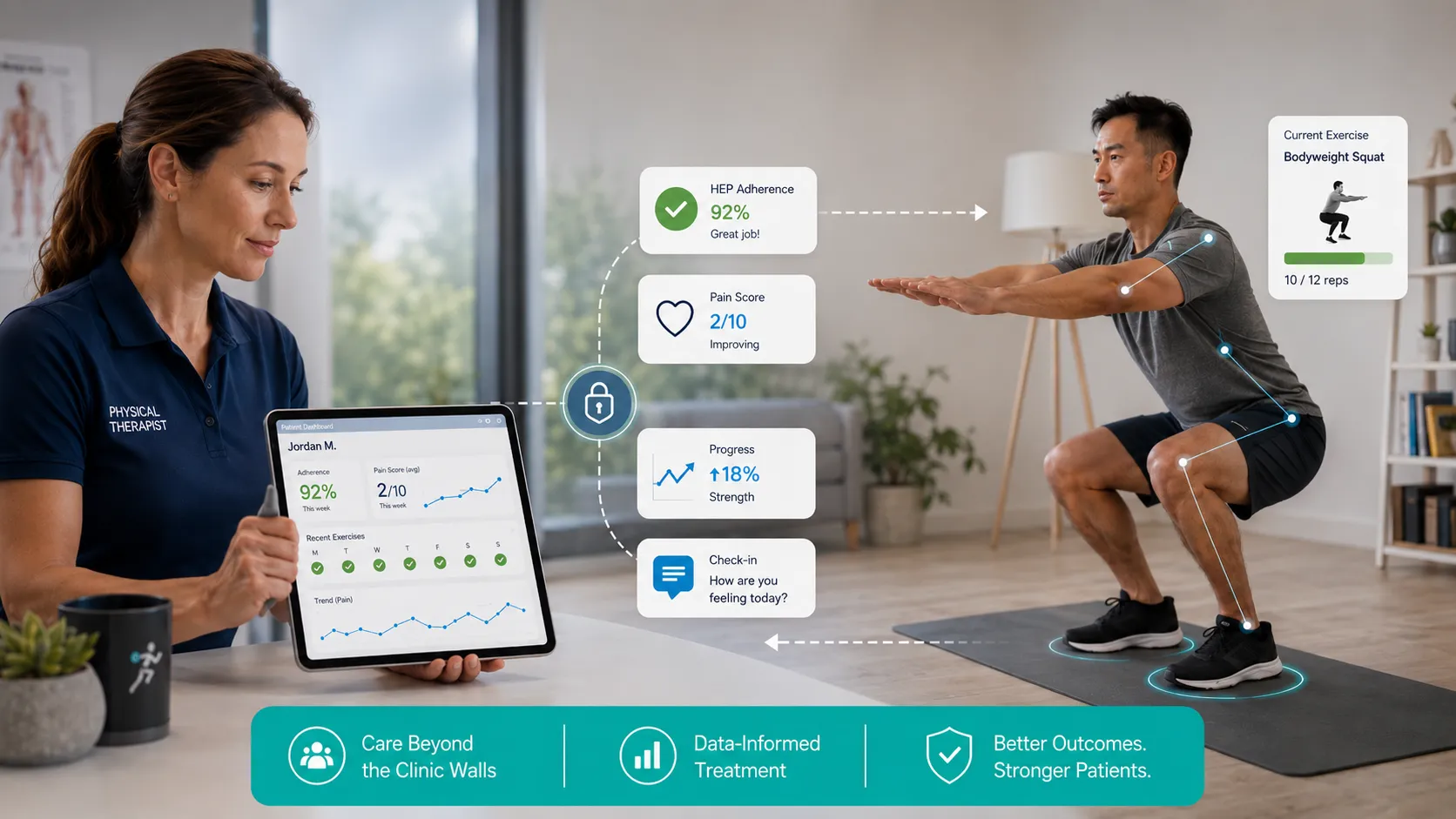
RTM is what bridges the gap between what we hope patients are doing and what's actually happening when they leave the clinic. It gives us real insight into whether patients are doing their exercises, whether they're doing them correctly, how they're feeling after sessions, and what their response looks like in real life, not just in the clinic.
3. The 2% Problem
Some may say, "But my patient is coming into the office 3x/week for 6 weeks already." Even in a typical post-op case, that's about 3 hours out of 168 hours in a week. The math doesn't favor in-clinic care alone:
- 3 hours/week in the clinic = less than 2% of a patient's time
- 168 hours/week — most of recovery, adherence, and decline happens outside our walls
- Without visibility into the other 98%, even excellent in-clinic care is incomplete
This is exactly why we need to change the narrative around RTM. Just like HEP, it shouldn't be optional. It should be expected.
4. What RTM Actually Gives Us
RTM lets clinicians do what we already want to do, stay connected to patients between visits and respond in real time. Specifically, it allows us to:
- Check in between visits — and see how patients are responding after treatment and exercise
- Track real-life performance — during daily activities, not just under clinician-guided conditions
- Adjust the HEP and review outcomes — in a timely, data-informed way between sessions
The Bottom Line
"If we want a more active, exercise-forward patient population, we have to become more tech-forward as clinicians. The tools are already here, the question is whether we're using them to their full potential."
RTM isn't just a nice add-on. It's how we extend care beyond the clinic walls, drive accountability, and create the conditions for the better outcomes the evidence already supports.
Why This Has to Become the Standard
MSK care has already moved from passive treatments to active rehabilitation. The next move is from in-clinic-only to continuous, meeting patients in the 98% of time we've historically had no window into. Here's how the standard needs to shift.
The 168-hour problem
What an MSK patient's week actually looks like
For a typical post-op patient in 3x/week PT, here's how a single week breaks down:
- ~3 hrs In-clinic time with their PT — guided exercise, manual care, education, and reassessment
- ~5 hrs HEP & home exercise if the patient is adhering — ideally daily, completed independently between visits
- ~160 hrs of everything else — work, sleep, daily life — where most of recovery actually plays out
What we miss between visits
That 98% of a patient's week happens outside our walls. It's where adherence is built or lost, where flare-ups go unaddressed, and where outcomes are quietly made or broken, without us seeing any of it.
Why HEP alone isn't enough
A great home exercise program is necessary, but on its own it isn't sufficient. Without visibility into whether patients are actually doing it, and how it's affecting them, we're still guessing once they leave the clinic.
What RTM closes the loop on
RTM gives clinicians the data we've always wanted between visits. For every patient on every program, we can finally answer the questions every MSK clinician already asks:
- Are they doing their exercises? — Adherence becomes measurable, not assumed, every day between visits.
- Are they doing them correctly? — Form and movement quality become visible, in real time with AI-assisted feedback.
- How are they feeling? — Pain and function get tracked — between sessions, not just at the next visit.
And critically: what's their response in real life, at work, on the field, doing the activities this rehab is supposed to return them to?
What you'd actually do with that
- In the moment Adjust the HEP in a timely, data-informed way, not weeks later when compensations have already set in.
- Every visit Bring objective outcome measures into reassessment, not just subjective recall.
Why this isn't extra work
RTM doesn't add a separate block to your day. It runs alongside the work clinicians are already doing, chart reviews, follow-up calls, HEP updates and gives that work a place to live, be measured, and be reimbursed.
Why this shouldn't be optional
If a home exercise program is non-negotiable for MSK recovery, the monitoring that supports it shouldn't be optional either. RTM is the natural extension of an evidence-based HEP.
Where the standard is headed
MSK care has already moved from passive to active. The next step is from episodic to continuous, using technology to stay connected through the entire arc of recovery, not just the one-hour appointments.
What the bar should look like
Every MSK patient gets an HEP. Every HEP-eligible patient gets RTM. That's the standard our profession should hold itself to, and the one our patients deserve.
When RTM is the standard, not the exception, every MSK patient gets the continuity of care between visits the evidence already says drives better outcomes. The tools are here. The bar is within reach. The next step is making sure every patient, not just some, actually crosses it.