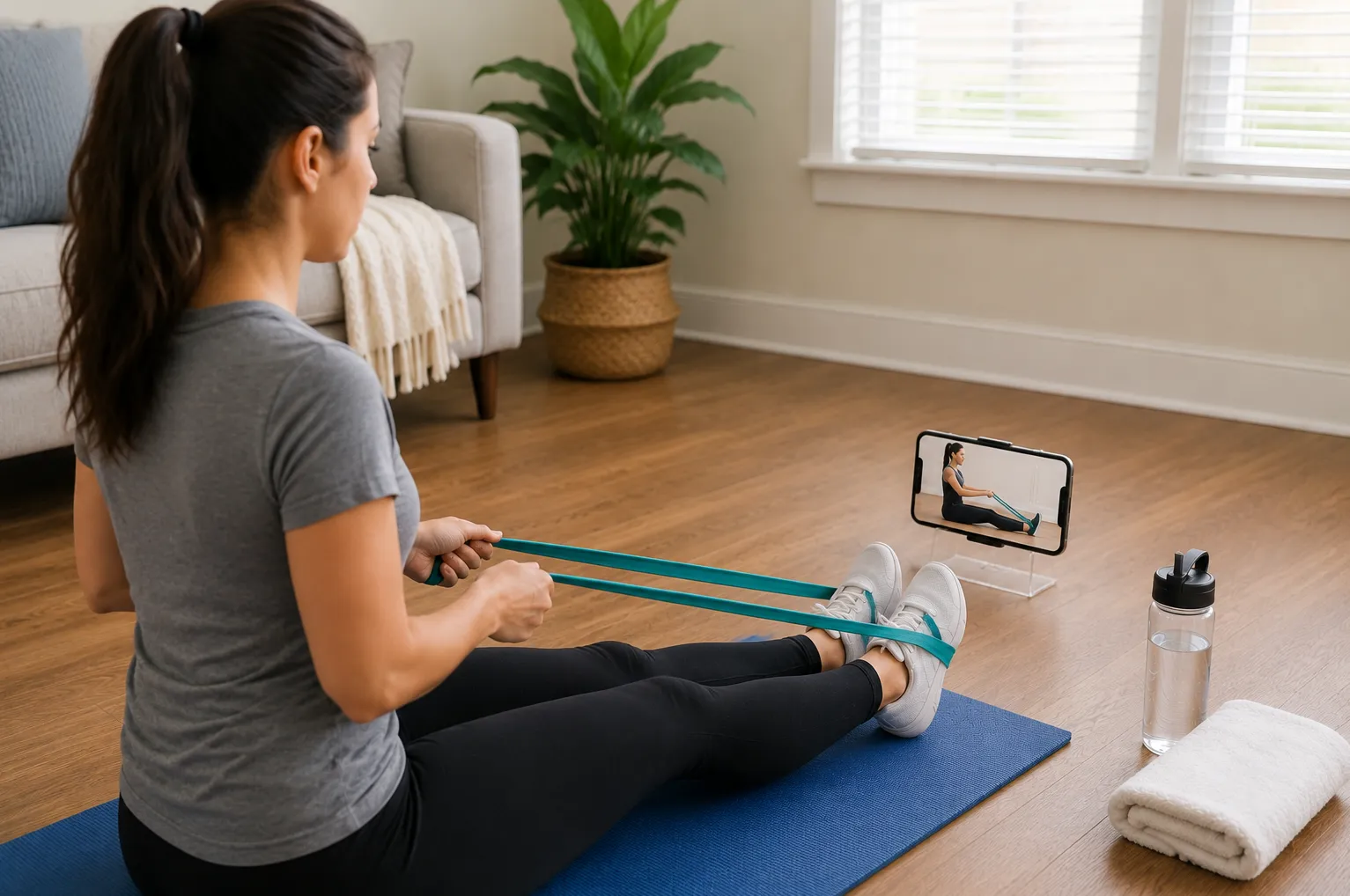
Home exercise programs (HEPs) are the bridge between in-person physical therapy visits and everyday life. Most patients attend therapy only two to three times a week, which means the majority of their recovery happens outside the clinic, on their own. That makes adherence to a prescribed home program one of the biggest factors in whether rehabilitation succeeds. Research and clinical experience agree: patients who follow their HEPs see better outcomes — less pain, improved function, greater mobility, and more lasting independence.
Why Home Exercise Programs Matter
Physical therapists prescribe HEPs in outpatient settings to reinforce the progress made during treatment. Each program is built around the patient's condition, stage of healing, and functional goals, and usually blends flexibility, strengthening, balance, and mobility work that can be done safely at home. Before a patient leaves with a program, the therapist confirms they understand proper form and can perform every exercise safely without supervision.
Patients spend a few hours a week in the clinic — and the rest of the week on their own. The home exercise program is where most of the healing actually happens.
The payoff reaches well beyond symptom relief. Consistent participation accelerates recovery, builds muscle memory through repetition, and lowers the risk of re-injury — helping patients reach their goals more efficiently.
Just as important, continuing therapeutic activity between visits lets patients hold on to the gains they make in the clinic instead of losing ground from one appointment to the next.
98%
of recovery happens outside the clinic
2–3×
in-clinic PT visits per week
<10 min
Ideal home session length — short programs get done
Why Patients Fall Off: The Most Common Barriers
Despite the clear benefits, non-adherence is one of the most common challenges in outpatient care. Patients regularly hit obstacles that get in the way of consistent exercise: time constraints, low motivation, pain, fatigue, uncertainty about whether they're doing the movements correctly, and the simple difficulty of fitting exercises into a busy day. Making it harder, several days often pass between supervised sessions — leaving patients without professional guidance at exactly the moment questions come up.
How to Make Home Exercise Programs Stick
The most effective way to improve adherence is to keep programs manageable and personal. Brief, focused sessions that slot easily into a patient's day feel far more achievable, and anything under ten minutes is less likely to overwhelm. Tying exercises to a patient's own goals — getting back to a sport, returning to work, living independently — drives motivation and commitment.
Two principles do most of the heavy lifting:
Keep it under ten minutes
Programs that take less than ten minutes feel achievable and are far less likely to be skipped. Shorter, focused sessions remove the “I don't have time today” excuse that derails so many home programs.
Tie it to what matters
When an exercise is connected to something the patient genuinely cares about — a hobby, their job, their independence — it stops feeling like a chore. Personal goals turn a prescribed routine into a reason to show up.
How Technology Closes the Gap
Technology has become one of the most powerful levers for engagement. When a home program lives on a digital platform, patients get detailed instructions, video demonstrations, prescribed repetitions, duration guidelines, and clear progressions — everything they need to exercise confidently on their own.
That visibility matters. Much of the uncertainty that derails adherence comes from not knowing whether an exercise is being done correctly, or what comes next. A digital HEP answers those questions in the moment, instead of leaving patients to guess until their next appointment.
But guidance on its own isn't the whole story. The bigger shift comes when that same platform keeps the clinic connected to the patient between visits.
Remote Therapeutic Monitoring: Support Beyond the Clinic
Remote Therapeutic Monitoring (RTM) extends clinical support beyond the four walls of the clinic. Through an RTM platform, patients can message their provider, report symptoms, ask questions, and get timely feedback between appointments. That ongoing line of communication surfaces problems early — so a clinician can step in before a small concern becomes a real barrier to recovery. Patients are encouraged to flag any discomfort during exercise, and a little education helps them tell the difference between normal therapeutic effort and pain that signals a problem. When several days remain before the next visit, a care coordinator can loop in the treating therapist to adjust the plan and keep care continuous.
Overcoming the Four Biggest Barriers
Most barriers to adherence are predictable — which means they're solvable. Here's how a short, connected, well-supported approach takes on the four most common obstacles:
Barrier 01
Time constraints
Prescribe brief, focused sessions. A program that takes less than ten minutes fits into even the busiest day, so patients are far more likely to actually do it.
Barrier 02
Low motivation
Connect every exercise to a goal the patient cares about — returning to work, a favorite hobby, or a sport. Motivation follows meaning.
Barrier 03
Lack of confidence
Add video demonstrations through a digital platform so patients can confirm their form any time. Seeing the movement done correctly removes the hesitation that leads to skipped sessions.
Barrier 04
Pain or fatigue
Use RTM to capture feedback right after a session. When a clinician sees a patient struggling, they can adjust the routine before the next visit — not a week later.
Addressed together, these tactics turn adherence from something patients have to white-knuckle alone into something the whole care team actively supports.
The Future Is Hybrid Care
Emerging research suggests that hybrid care models — pairing in-person therapy with remote monitoring — improve engagement and contribute to better functional outcomes. Patients in these models consistently report higher satisfaction, largely because support and guidance are available throughout recovery rather than only during appointments.
As healthcare evolves, RTM is becoming an essential extension of physical therapy. Home exercise programs remain the cornerstone of rehabilitation — and as hybrid care expands, patients stay engaged while clinicians gain the tools to catch challenges before they stall progress.
The Bottom Line
Home exercise programs are where recovery is won or lost. They reinforce clinical progress, build independence, and carry patients through the days between visits — but only if patients actually follow them.
By keeping programs short and personal, backing them with clear digital guidance, and staying connected through Remote Therapeutic Monitoring, clinics can turn adherence from a persistent challenge into a built-in part of care — and give patients the best possible shot at a full recovery.
References
1. Chaughule, S., & Bhonde, I. (2025). Influence of Remote Therapeutic Monitoring on Efficiency and Effectiveness of PT in Home Health Settings. Research and Reviews: Journal of Medical Science and Technology. https://pubmed.ncbi.nlm.nih.gov/40980535/
2. O'Brien Physical Therapy. The Importance of Home Exercise Programs in Recovery. https://www.obrienphysicaltherapy.net/blog/the-importance-of-home-exercise-programs-in-recovery
3. Supplemental educational video. https://youtu.be/FMPFFDNsXrM