


August 10th, 2026
Digital Therapeutic for Patellofemoral Pain
Explore EverEx research presented at AOSSM 2026 on a randomized controlled trial evaluating MORA Care for patellofemoral pain.
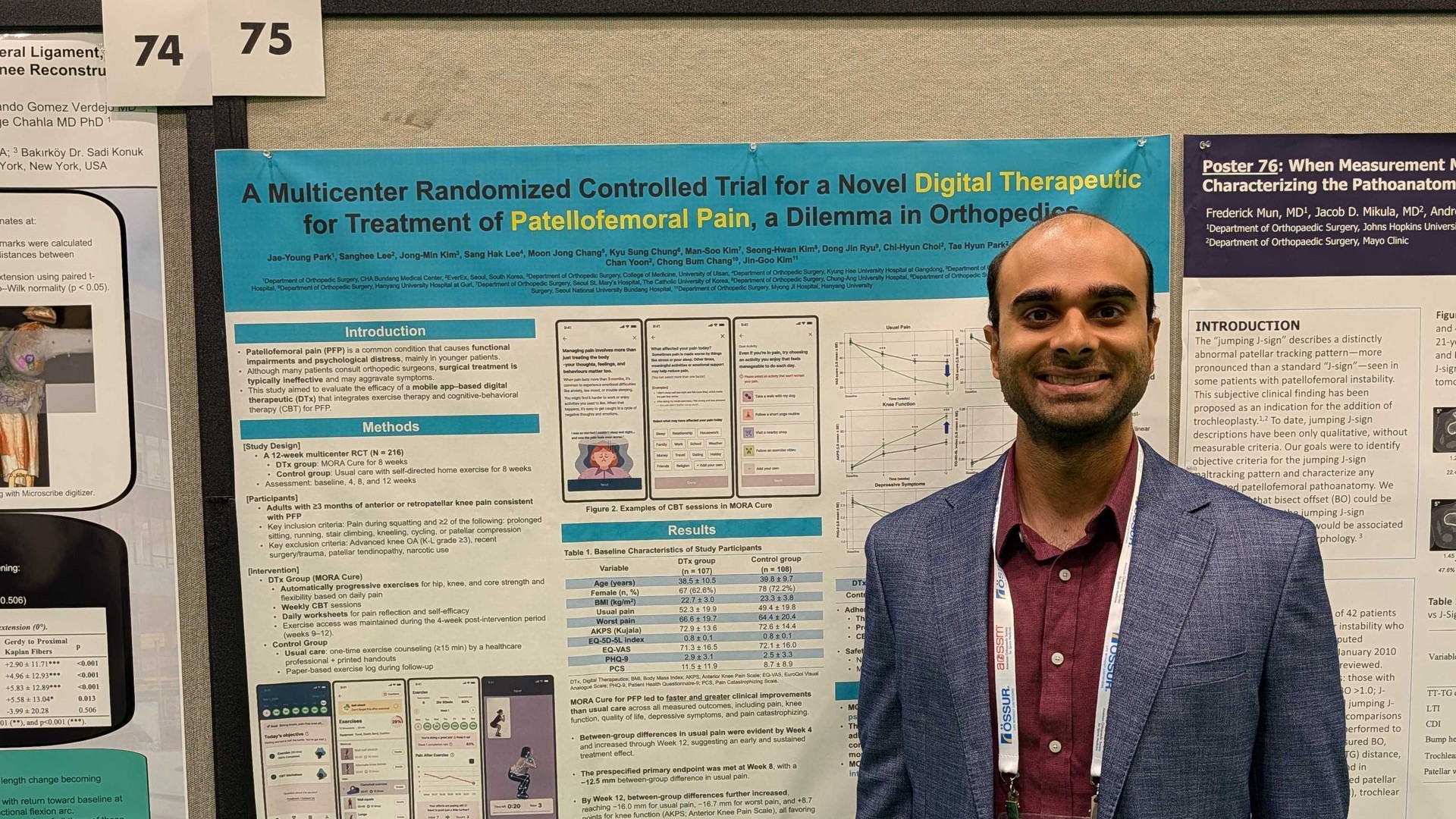
A multicenter randomized controlled trial presented by EverEx at the AOSSM Annual Meeting 2026 evaluated MORA Care, a digital therapeutic for adults with patellofemoral pain. The 12-week study compared the digital therapeutic with usual care and evaluated outcomes including pain, knee function, quality of life, psychological measures, adherence, and safety.
The findings showed that MORA Care significantly improved pain, knee function, and psychological outcomes compared with usual care in patients with patellofemoral pain.
Presented during the AOSSM Annual Meeting in Seattle, the research adds to the growing conversation around how digital therapeutics may support orthopedic rehabilitation beyond traditional clinical encounters.
| Study detail | Description |
|---|---|
| Study type | Multicenter randomized controlled trial |
| Study duration | 12 weeks |
| Participants | 216 adults |
| Condition | Patellofemoral pain |
| Digital intervention | MORA Care |
| Intervention period | 8 weeks |
| Comparator | Usual care with self-directed home exercise |
| Assessments | Baseline, 4 weeks, 8 weeks, and 12 weeks |
| Key areas evaluated | Pain, knee function, quality of life, psychological outcomes, adherence, and safety |
| Presented at | AOSSM Annual Meeting 2026 |
| Location | Seattle, Washington |
Patellofemoral pain, or PFP, is a common orthopedic condition that can cause functional impairment and psychological distress. The study included adults who had experienced anterior or retropatellar knee pain associated with patellofemoral pain for at least three months.
The poster also highlights an important challenge in treating PFP. Although many patients consult orthopedic surgeons, surgical treatment may not provide the desired improvement for every patient. This creates a need to continue evaluating effective non-operative approaches to patellofemoral pain treatment and rehabilitation.
One area being investigated is whether digital therapeutics can provide more structured support for patients completing rehabilitation outside the clinic.
In this randomized controlled trial, participants in the digital therapeutic group used MORA Care for eight weeks.
The program combined several components within a home-based digital care model:
Rather than evaluating exercise alone, the study examined an integrated digital treatment model combining therapeutic exercise with behavioral support and daily patient self-monitoring.
That distinction is important when considering how digital rehabilitation may fit into orthopedic care. Learn more about digital support for musculoskeletal patients and orthopedic providers.
Researchers conducted a 12-week multicenter randomized controlled trial involving 216 adults with patellofemoral pain.
Participants were assigned to either the MORA Care digital therapeutic group or a control group receiving usual care with self-directed home exercise.
Patient assessments occurred at baseline, Week 4, Week 8, and Week 12. This allowed researchers to examine changes during the eight-week treatment period as well as whether differences between the groups continued after the primary intervention period.
The trial evaluated several dimensions of the patient experience, including pain, knee function, quality of life, depressive symptoms, pain catastrophizing, adherence, and safety.
The study reported that MORA Care produced greater clinical improvements than usual care across the measured outcomes.
Between-group differences in usual pain were observed by Week 4 and continued through Week 12, which the researchers described as evidence of an early and sustained treatment effect.
The study's prespecified primary endpoint was met at Week 8, with the difference between the digital therapeutic and usual-care groups continuing to increase by Week 12.
The findings suggest that the effects observed with the digital therapeutic were not limited to the end of the active treatment period.
The MORA Care group also demonstrated greater improvement in measures of knee function compared with usual care.
This is particularly relevant when evaluating patellofemoral pain rehabilitation because the clinical objective extends beyond reducing pain. Improving how patients function is also an important part of determining whether a treatment is helping them progress.
The study's conclusion specifically identified knee function alongside pain and psychological outcomes as an area where MORA Care significantly improved outcomes compared with usual care.
Researchers also evaluated outcomes beyond physical symptoms. According to the poster, MORA Care demonstrated improvements across measures that included quality of life, depressive symptoms, and pain catastrophizing.
These findings are noteworthy because the digital therapeutic included more than therapeutic exercise alone.
The breadth of improvements observed may reflect the value of an integrated treatment model combining personalized exercise, CBT-delivered support, and daily self-monitoring.
The trial also evaluated patient adherence to the rehabilitation program. The poster reports adherence across several areas, including threshold-based exercise participation, progression-based exercise participation, and CBT session completion.
Importantly, the researchers noted that the broader improvements in patient outcomes occurred despite what they characterized as relatively modest differences in exercise adherence between the groups.
That observation contributed to the study authors' interpretation that the combination of exercise, behavioral support, and regular self-monitoring may have contributed to the results rather than exercise participation alone.
Safety was also evaluated throughout the study. According to the poster, no serious device-related adverse events were reported, and mild musculoskeletal symptoms occurred in both study groups at similar rates.
The safety findings, combined with the clinical outcomes reported during the trial, led the researchers to describe MORA Care as an evidence-based home digital treatment option that can be integrated into clinical care for patellofemoral pain.
The research addresses a broader question facing orthopedic and sports medicine providers: how can structured rehabilitation support continue when the patient is outside the clinic?
The MORA Care study evaluated one potential approach. By combining personalized therapeutic exercise, cognitive behavioral support, daily patient assessments, and digital delivery, the intervention created a more comprehensive home-based treatment model for patients with patellofemoral pain.
For providers evaluating how technology can support patients across the musculoskeletal care journey, research like this helps move the conversation from what digital health could do toward what can be evaluated through clinical evidence. Learn more about how EverEx supports physicians and health systems delivering musculoskeletal care.
EverEx presented the research during the AOSSM Annual Meeting 2026, held July 8 through July 11 at the Seattle Convention Center | Arch in Seattle, Washington.
The annual meeting brought together more than 2,000 professionals from across sports medicine for research, education, innovation, and collaboration, with more than 150 presentations, lectures, debates, and educational sessions throughout the event.
Presenting the MORA Care randomized controlled trial at AOSSM provided an opportunity to contribute clinical evidence to the discussion around digital therapeutics, non-operative orthopedic care, and the future of musculoskeletal rehabilitation.
For EverEx, that evidence remains central to a larger goal: exploring how technology can help extend meaningful therapeutic support beyond the traditional clinical encounter. Request a demo to see our approach to digital musculoskeletal care.
The randomized controlled trial evaluated MORA Care, a digital therapeutic combining personalized therapeutic exercise, weekly CBT sessions, daily patient assessments, and digital self-management support.
The multicenter randomized controlled trial lasted 12 weeks. The MORA Care intervention was delivered for eight weeks, with assessments conducted at baseline and Weeks 4, 8, and 12.
The trial included 216 adults with patellofemoral pain.
According to the findings presented at AOSSM 2026, MORA Care significantly improved pain, knee function, and psychological outcomes compared with usual care.
The study reported no serious device-related adverse events. Mild musculoskeletal symptoms were reported in both groups at similar rates.
Findings summarized from the poster “A Multicenter Randomized Controlled Trial for a Novel Digital Therapeutic for Treatment of Patellofemoral Pain, a Dilemma in Orthopedics,” presented at the AOSSM Annual Meeting 2026. This article is for informational purposes only and is not medical advice.
Our latest news and trending topics