

May 29th, 2026
EverEx Recognized at ESSKA 2026
EverEx earned the Best Original Health Science Abstract Award at ESSKA 2026 and was featured in an HSS keynote on AI-powered remote therapeutic monitoring.
PRAGUE — May 2026. At the 22nd ESSKA Congress, held 20–22 May at the O₂ Universum in Prague under the theme History Inspires Science, EverEx earned one of the meeting's top scientific honors and saw its technology featured from the keynote stage. For a company built to solve one of the most stubborn problems in orthopaedic and sports medicine, it was a defining moment.
EverEx received the Best Original Health Science Abstract Award, recognizing the clinical research behind its AI-powered digital therapeutics platform. CEO and orthopaedic surgeon Dr. Alex Yoon accepted the recognition on behalf of the EverEx team, the clinicians, and the researchers who participated in the company's clinical trials.
“I'm deeply honored to accept this recognition on behalf of the entire EverEx team and all of the clinicians and researchers who participated in our clinical trials. This milestone belongs to all of them.” — Dr. Alex Yoon, CEO of EverEx, Orthopaedic Surgeon
EverEx traces its origins to a clinical frustration shared by orthopaedic and sports medicine clinicians worldwide: patellofemoral pain (PFP), one of the most prevalent chronic knee conditions and one of the hardest to treat effectively.
“When I first started EverEx, one of the conditions I saw most frequently and one of the hardest to treat effectively, was patellofemoral pain,” Dr. Yoon reflected. “I wanted to build something that could genuinely help these patients.”
That ambition grew into a broader mission: to develop AI-powered digital therapeutics that deliver measurable clinical impact across the musculoskeletal care continuum. The award at ESSKA 2026 marks an external, peer-reviewed validation of that work, promising clinical trial results recognized on one of the field's most respected international stages.
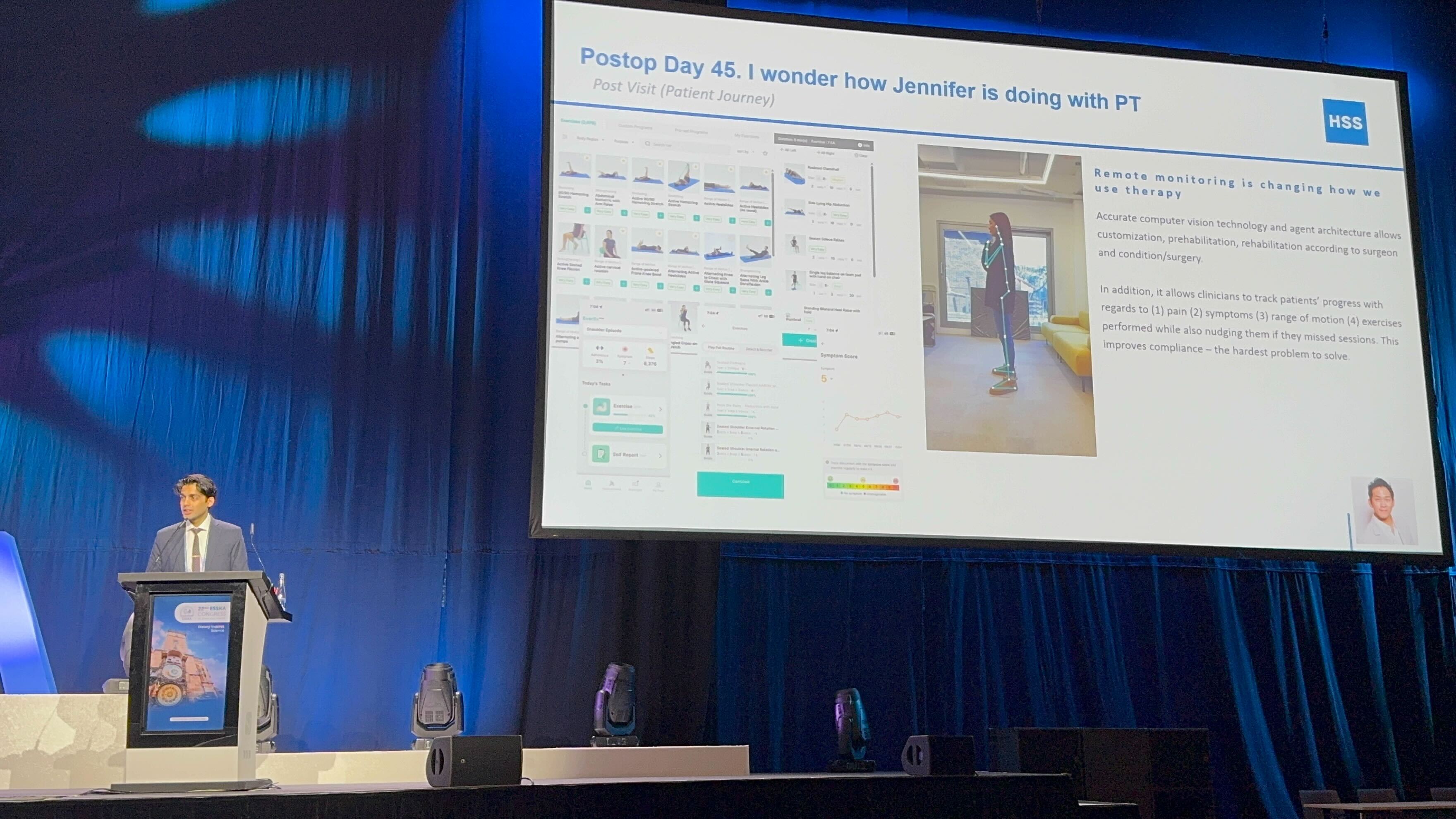
Beyond the awards ceremony, EverEx's platform was spotlighted from the keynote stage during a lecture by Ayoosh Pareek, MD, of the Hospital for Special Surgery (HSS), one of the world's leading orthopaedic institutions as part of a session on the AI revolution in musculoskeletal healthcare. With EverEx's remote-monitoring interface on screen, Dr. Pareek walked the audience through the post-operative patient journey and made the case that the next frontier in rehabilitation is visibility into what happens between visits.
He framed the gap with a scenario every surgeon recognizes:
“A few weeks pass and you wonder if Jennifer is doing well in physical therapy. Her knee was really stiff, you want to make sure she's getting range of motion back. You can't keep track of every patient.”, Ayoosh Pareek, MD, Hospital for Special Surgery
The pressures, he argued, are only intensifying: “While the margin for operating is decreasing and you're increasing your own workload, these things need to be automated.” The question he posed was how to scale care without sacrificing it — “How do we make sure that as these demands grow we take care of patients and our quality doesn't decrease?”
His answer pointed directly at the kind of technology EverEx builds. Agentic AI, he noted, can already handle much of the standardized post-operative follow-up:
“There's no reason why agentic AI can't do most standardized tasks that you ask it to, such as inquiring about pain, swelling, signs of infection, red-flag symptoms… Of course a human touch is best and it will be required — it's not going away — but it doesn't mean technology can't be used responsibly to create more touch points.”
On rehabilitation specifically, Dr. Pareek described how computer-vision technology and agent architectures can tailor recovery to the surgeon's preferences and the patient's condition, and, critically, keep patients engaged:
“In addition, they allow us to examine multiple outcomes while maintaining compliance. This, in my opinion, is the hardest problem to solve in physical therapy or rehabilitation. I never know when my patients are going to physical therapy or what quality of therapy they're receiving.”
That is precisely the gap EverEx is built to close, tracking pain, symptoms, range of motion, and exercises performed between visits, while nudging patients who miss sessions. And the clinical case for the approach, Dr. Pareek emphasized, is already mounting:
“Studies over and over have shown that digital rehabilitation is similar or even greater outcomes in muscle strength, function, and quality of life compared to usual in-person care. And I suspect it's because of compliance and adherence.”
For clinicians, those lines land. Adherence to home exercise programs is notoriously low, and poor compliance undermines even technically excellent surgery. A platform that can measure, personalize, and reinforce rehabilitation between appointments — and extend it to patients in rural areas or high-demand settings who lack easy access to in-person rehab, speaks directly to outcomes, throughput, and the economics of recovery.
EverEx sits at the intersection of three converging trends in musculoskeletal medicine.
Digital therapeutics are maturing from novelty to evidence. Recognition through the Best Original Health Science Abstract Award signals that EverEx's clinical claims are being evaluated, and validated by the orthopaedic research community itself, not just the market.
Remote Therapeutic Monitoring (RTM) is becoming standard of care. As reimbursement and clinical workflows increasingly accommodate RTM, platforms that can reliably capture pain, symptoms, range of motion, and adherence between visits are positioned to become core infrastructure for rehabilitation, not optional add-ons.
Computer vision plus agentic AI unlocks personalization at scale. EverEx's architecture allows rehabilitation to be customized to the surgeon's protocol and the patient's specific procedure, then continuously adapted, the kind of one-to-one care that has historically been impossible to deliver outside of high-touch, high-cost settings.
For clinical partners, this points to better adherence, earlier intervention when recovery stalls, and richer data on real-world outcomes. For investors and strategic partners, ESSKA 2026 is a marker of credibility: independent recognition, validation from a leading institution like HSS, and a clear line of sight from a well-defined clinical problem to a scalable platform spanning prehabilitation through rehabilitation.
The moment carried personal weight for Dr. Yoon. His mentor, Prof. Chong Bum Chang, was present at the award ceremony, and the recognition included acknowledgment from Dr. David H. Dejour, a name synonymous with patellofemoral research. For a company that began with the goal of helping PFP patients, earning recognition in front of the field's most respected figures was, in Dr. Yoon's words, “incredibly humbling.”
If ESSKA 2026 validated the science, the work ahead is about reach. “Now comes the most important part,” Dr. Yoon said. “Bringing this technology to the patients who need it most.”
That is the throughline from a Prague stage back to the clinic: turning recognized research into routine care, and turning a hard problem, compliance into a solved one. As Dr. Pareek put it in closing his keynote, the field may finally be at an inflection point:
“I'm not sure we've had our industrial moment yet, but things are now starting to happen all at once. A variety of factors are coming together which have the potential to help us and our patients.”
EverEx is partnering with surgeons, health systems, and rehabilitation programs to bring AI-powered digital therapeutics and remote therapeutic monitoring into everyday practice. To see how EverEx can support your patients' recovery — from prehabilitation through rehabilitation — get in touch with our team.
Our latest news and trending topics